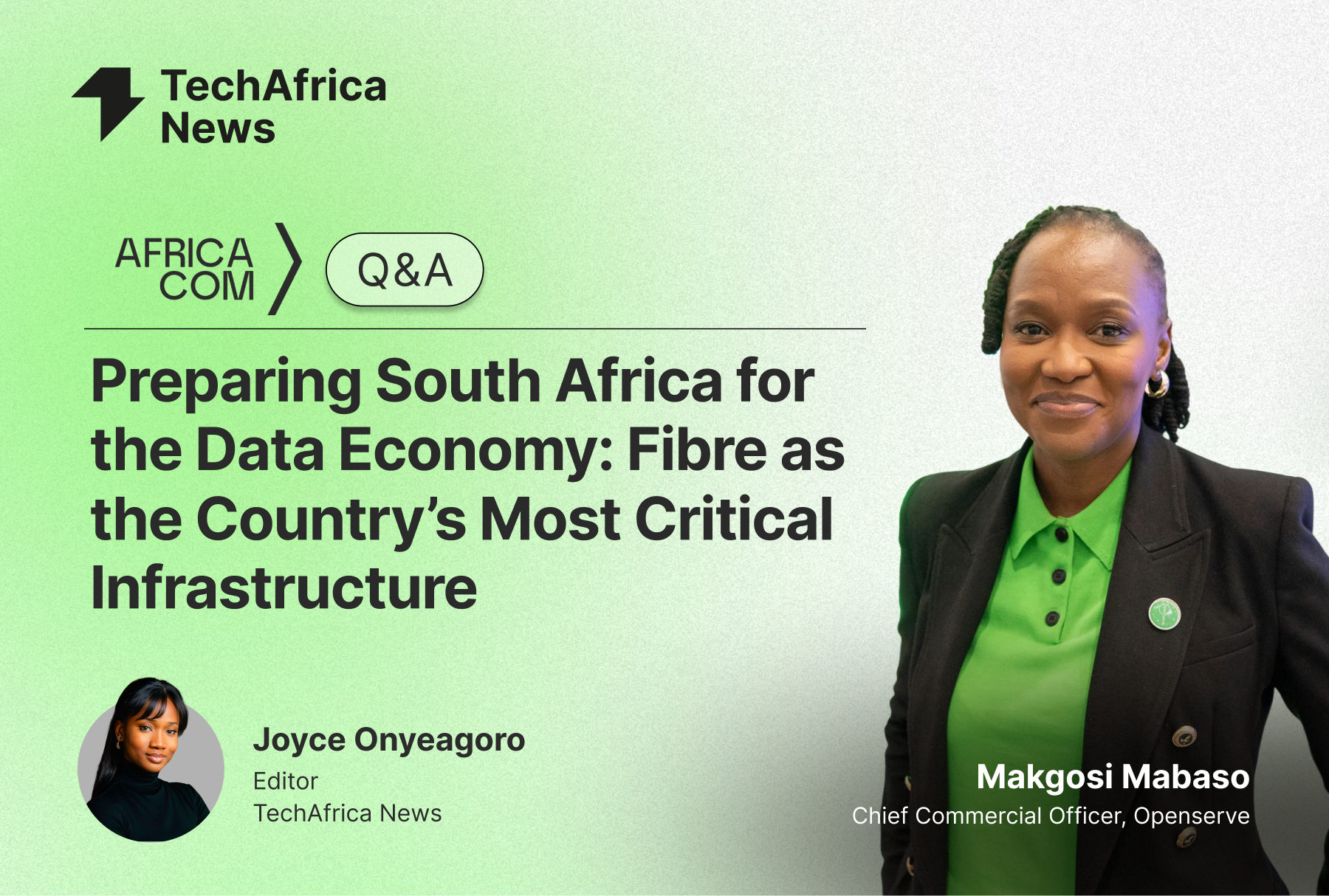
Preparing South Africa for the Data Economy: Openserve on Fibre as the Country’s Most Critical Infrastructure
Fibre has become one of the most influential enablers of Africa’s digital shift. It supports the rise of remote work, powers cloud adoption, strengthens national digital services, and unlocks opportunities for communities that were once far from the digital grid. Over the past few years, South Africa has taken a leading position in terrestrial fibre deployment, yet the real story lies in how fibre is being extended beyond high-density metros into peri-urban and rural communities where digital inclusion matters most.
Openserve continues to play a central role in this transformation, especially as the country leads the continent in terrestrial fibre expansion. Its wholesale network and rollout strategy have shaped how homes, businesses, government facilities, and mobile operators access fast and reliable connectivity. From exploring prepaid wholesale models to targeting overlooked regions, the company is redefining how fibre reaches people and how communities adopt it.
At AfricaCom 2025, TechAfrica News Senior Editor, Joyce Onyeagoro, had a chat with Makgosi Mabaso, Chief Commercial Officer at Openserve. Their conversation unpacked the progress made in the last five years, the operational and policy hurdles still slowing deployment, and the practical actions needed to prepare fibre networks for a future defined by 5G, cloud, AI, and nationwide IoT services.
Openserve plays a critical role in South Africa’s digital infrastructure. How do you see fibre shaping the country’s economic future over the next five years particularly for SMEs and the digital economy?
Fibre is, if there is a better way to describe it, the fuel of this economy. When you look at SMMEs, this becomes very clear. I remember the period of load-shedding when we did not have electricity and we did not have data at the same time, because when load-shedding occurred, many of the towers went down.
It was a proper doubling, if I can put it that way. That is when you begin to see that fibre for SMMEs is truly their oxygen, because they could not operate. During that period, the GDP almost collapsed. Connectivity is one of the most important elements in sustaining economic activity.
To make it practical, fibre enables an SMME to provide its products and services beyond its immediate boundaries. You can provide your products and services not only where you reside, but also outside your area, and even overseas, if I can put it that way. That is one.
Second, we are finding that fibre creates a platform for entrepreneurship for many SMMEs. You can refer to influencers and the growing number of podcasts in the market. None of these would be possible without solid and reliable connectivity for those SMMEs.
In my view, fibre plays a significant role in the economy, and it will continue to do so, especially with the advancement of artificial intelligence. SMMEs are constantly seeking ways to perform the same tasks better, faster, and at scale, if I can put it that way.
All of this is anchored by fibre connectivity.
As South Africa’s digital economy gains momentum, which investment models and partnership frameworks are proving most effective in scaling fibre infrastructure, both profitably and sustainably?
A very important question, because from an Openserve perspective, we are aware that we cannot be appropriate to everyone. The concept of partnership is not strange to us. It is core to our strategic intent.
Partnerships are central to how we operate. We work very closely with ISPs, for example. We lay the fibre as an FNOs, and the ISPs are the ones who take it to the market. They take it to homes, they take it to businesses, and they take it to enterprises.
Therein lies the opportunity. We ensure that we commercialize the fibre we deploy, and by enabling these three categories of customers, we create value. That is one.
Secondly, we are starting to see very interesting models emerging. We have landlords who now say they are willing to co-invest when we deploy fibre. Instead of us spending ten bucks, we may spend five, and then find interesting ways to share the revenue. That reflects the reality that we cannot do everything on our own.
We must be able to partner. The concept of sustainability is wide. It is a significant responsibility. There is no way it can rest on one person or one organisation. It requires multiple parties coming together to create that value.
“What we are also finding is that, as an FNO, we have our own competitors. However, we are beginning to see collaboration with those competitors. Where they have fibre and we do not, it becomes less of a competition and more of a partnership. There is no point in building fibre where it already exists. Instead of saying, “You have it here, I have it there,” we explore ways to exchange value in different forms. It is interesting because the people you might think of as competitors can become your partners, and that works both ways as well.”
-Makgosi Mabaso, CCO, Openserve

The last mile remains one of the most complex and costly parts of deployment in Africa. What is Openserve’s strategy to accelerate rollout in harder to reach communities?
When we think about the last mile, our focus is on how to leverage what we already have. OpenServe is an open access network with approximately 180,000 kilometers of fibre across South Africa, which is a significant advantage.
This infrastructure allows us, when targeting specific areas, to avoid building entirely from scratch. In many cases, we already have fibre in place, and it is a matter of extending it from here to there. This approach helps us keep access costs manageable. For a new entrant in the market, deploying fibre can be an extremely expensive undertaking. Fibre deployment is capital-intensive, so we are constantly seeking ways to do things more efficiently and cost-effectively.
Another strategy is leveraging anchor tenants. For example, we have partnerships with organisations such as CETA, where we provide connectivity to government facilities and clinics. By building around these existing points, we can extend connectivity to nearby households, because clinics and government offices are naturally surrounded by communities.
We are always deliberate about where we deploy fibre, ensuring that it will be effectively utilised. This requires long-term planning, not one-year cycles. We plan five, ten, even fifteen years ahead. Data consumption will only continue to grow, and no FNO, nor any mobile telco, will report declining traffic. Demand is consistently increasing.
As we plan and build, we take this growth into account, ensuring that our fibre network meets future needs efficiently.
Fibre is the foundation for emerging technologies like 5G, AI, cloud computing, and data centres. What strategic partnerships can Openserve forge to accelerate fibre’s economic and social value creation?
So, we already have partnerships like Google, for example. We partnered with Google on their undersea cable capacity, which then enables South Africans to experience their services closer, without having to worry about latency and those types of issues. You cannot talk about AI, 5G, or cloud computing without anchoring them with reliable connectivity, like fibre or 5G.
Going forward, fibre and those three technologies mentioned, we are going to talk about them interchangeably, if I can put it like that. One cannot exist alone without the others. All three involve the consumption of data. AI is going to consume a lot of data, 5G is going to consume a lot of data, and cloud computing is a result of data consumption.
As data travels – from left to right, north to south, however you want to put it, we want to make sure it moves through pipes that are reliable, solid, and able to deliver whatever is needed to the customers.
Public private partnerships are essential to unlock nationwide connectivity. What is Openserve’s perspective on long term PPP models for rural broadband and smart infrastructure
For me, it is a no-brainer. I think the partnerships will become smarter. The partnerships will be non-traditional, right?
For me, a partnership with landlords, still in my mind, is non-traditional because there was once a time when landlords would not even have any issues with F and Os coming in, providing connectivity. Now, the landlords are looking for non-GLA type of revenue as well. They are asking, “What does it mean for me?”
The beauty of it is that landlords are now saying, “While I am building, you might as well bring your fibre,” because that actually starts reducing your cost. They are becoming open-minded about how to co-invest as a team, so that when we finish putting the building together and lay the fibre, our customers are fully connected.
I can tell you now, tenants are no longer willing to walk into a building for the sake of walking around and ask, “Do you have connectivity?” If there is no connectivity, they are not interested. These two worlds have now started to intertwine so much that there is no way this partnership cannot exist. I call it non-traditional.
Let us see how it goes, but I think it will take its own shape and form as we move on.
How is Openserve addressing the digital divide by extending fibre connectivity to underserved and unconnected communities across South Africa?
We have a gift of various solutions in our store. We have satellite, we have microwave, we are part of a Telkom group, so we have telecom mobile as a service, and we have fibre. The beauty of having all these options is that when a question arises about how to provide connectivity and bridge the digital divide, we can be technology agnostic.
Depending on the location, we can fulfill the requirement using different options. In some cases, it makes sense to deploy fibre because it is cost-effective. In other cases, a telecom mobile tower is the better option, especially in white areas. In more rural locations, we may need to consider satellite. That is the advantage of having not just one solution, but all four.
Having these four options also allows us to build redundancy. In areas where fibre is cut, there is always an alternative available. We, like all FNOs, have built a lot of fibre in local suburbs. Now, we are focusing on expanding fibre into townships, which requires innovation around the types of products and services that make sense for those markets.
That is really how we approach it. We track our numbers closely. We monitor township fibre rollout, uptake, and evaluate whether our products and services are achieving the desired adoption. This helps us refine our approach to ensure better uptake.
Closing the digital divide is critical, especially given the high unemployment in South Africa. Connectivity has a role to play in addressing this. My earlier examples around influencers and podcasts show how connectivity enables income generation. Without it, these opportunities would not exist.
We are proud at OpenServe to be at the forefront of this effort. We believe we are the backbone of South Africa in providing connectivity, and we aim to do even more as we move forward.