Where Direct-to-device Satellites Work Best and Where They Don’t
But while D2D is technologically impressive, its practical impact is far more geographically specific than headlines suggest. A closer reading of the Spectrum and Rural Connectivity report from GSMA highlights a central reality: D2D works best where almost nothing else does.
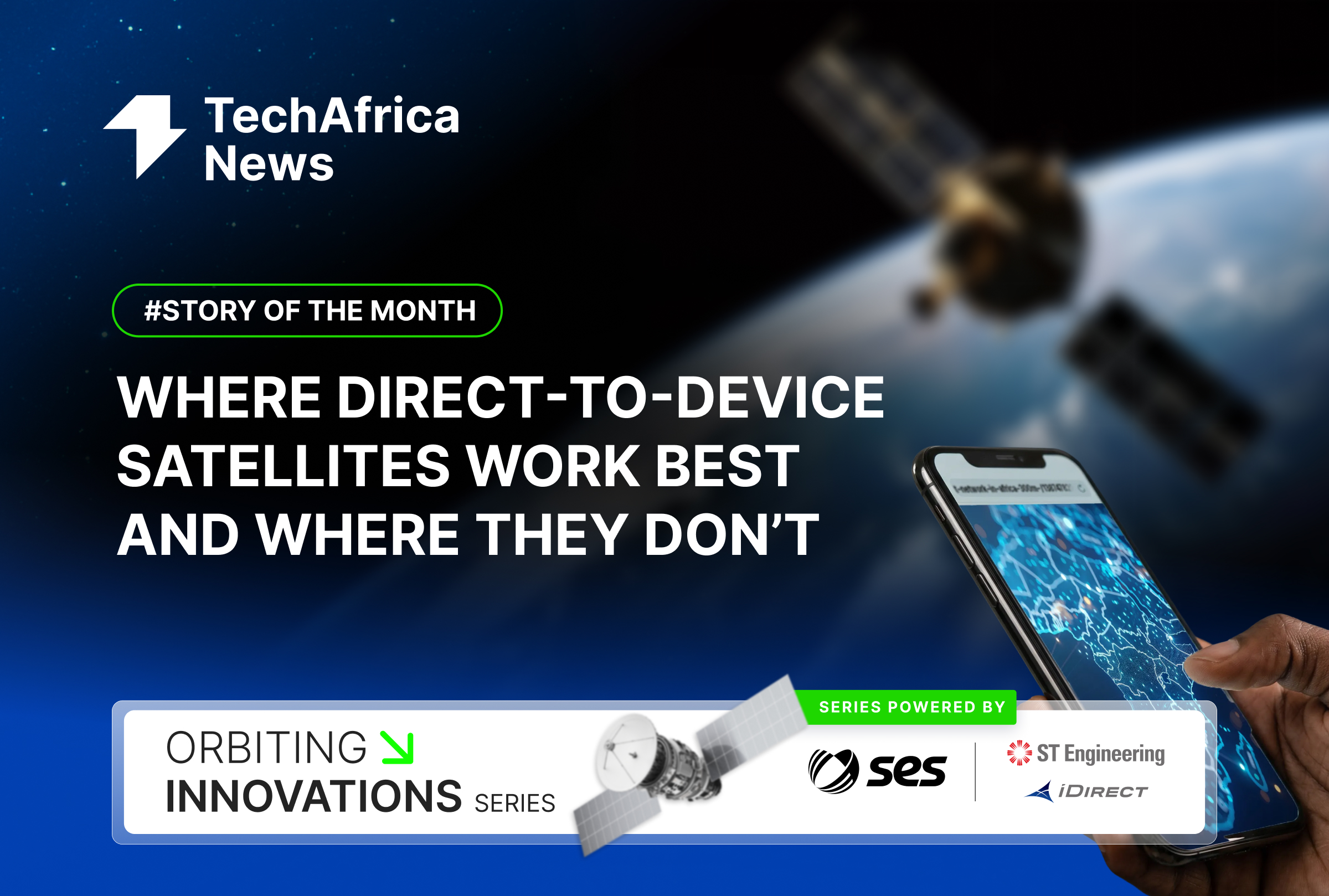
Direct-to-device (D2D) satellite connectivity has been framed as a breakthrough moment for global access. The promise is elegant: satellites in low Earth orbit connecting directly to ordinary smartphones: no dish, no tower, no terrestrial infrastructure.
For Africa, where vast rural areas remain under-served, the narrative is especially compelling.
But while D2D is technologically impressive, its practical impact is far more geographically specific than headlines suggest. A closer reading of the Spectrum and Rural Connectivity report from GSMA highlights a central reality: D2D works best where almost nothing else does.
Big Reach, Smaller Bandwidth
D2D satellites transmit signals across extremely large footprints. That wide-area coverage is their strength, but also their limitation.
Unlike terrestrial 4G or 5G networks, which rely on dense cell sites and targeted spectrum use, satellites must distribute capacity across vast geographies. The result is lower spectral efficiency and constrained throughput compared to ground-based networks.
In simple terms: D2D is excellent for reach but it is less efficient for density. That distinction matters enormously in Africa.
Where D2D Actually Makes Sense
D2D satellite connectivity is well suited for:
- Ultra-remote desert or savannah regions
- Offshore and maritime zones
- Remote mining and oil operations
- National parks and conservation areas
- Emergency and disaster-response scenarios
In these environments, population density is extremely low. The number of simultaneous users per beam is limited. Coverage, not capacity, is the priority.
Here, D2D is not competing with mobile networks. It is extending connectivity beyond the edge of terrestrial viability.
Where It Does Not Compete Well
The challenge appears in rural towns, villages, and agricultural clusters, the very places often highlighted in connectivity gap discussions.
These areas may lack full 4G coverage, but they are not uninhabited. As soon as user density increases, demand for bandwidth rises sharply. Video consumption, mobile money transactions, social platforms, and AI-enabled services all require sustained capacity.
Satellite beams cannot match the efficiency of a properly deployed terrestrial network serving the same population cluster. The GSMA analysis underscores that low-band spectrum expansion significantly increases rural coverage and speeds — something D2D cannot replicate at scale.
In moderately populated rural areas, terrestrial networks remain more scalable and more cost-effective.
A Layer, Not a Leapfrog
Direct-to-device satellites are exciting, but they are not a one-size-fits-all solution. Satellite broadband can cost a lot more than regular mobile data, and while D2D works well for messaging or emergency use, everyday internet—streaming, social media, or mobile money, can get expensive fast. In many communities, prepaid mobile data still makes the most sense.
There’s also a bigger-picture consideration. Treating D2D as a substitute for building out rural networks could slow investment in low-band spectrum and terrestrial infrastructure, which actually provide more reliable coverage and long-term value. D2D shines as a backup, a last-mile fix for really remote spots—not a full replacement for village-level broadband.
The most credible future is layered:
- Terrestrial networks covering populated rural areas
- Expanded low-band spectrum reducing deployment costs
- D2D satellites serving ultra-remote and emergency scenarios
In that architecture, D2D plays a vital role, but a precise one. Direct-to-device satellites do sound revolutionary. And in specific contexts, they are.
But in towns and villages across Africa, the connectivity equation remains grounded — in spectrum policy, infrastructure economics, and the steady expansion of terrestrial mobile networks.
Revolutionary technologies still obey physics.