EP.05 | S2 | Could Satellites Free Africa from Network Limits? ST Engineering iDirect on Multi-Orbit Connectivity
What will it take to connect Africa at scale, sustainably and intelligently?
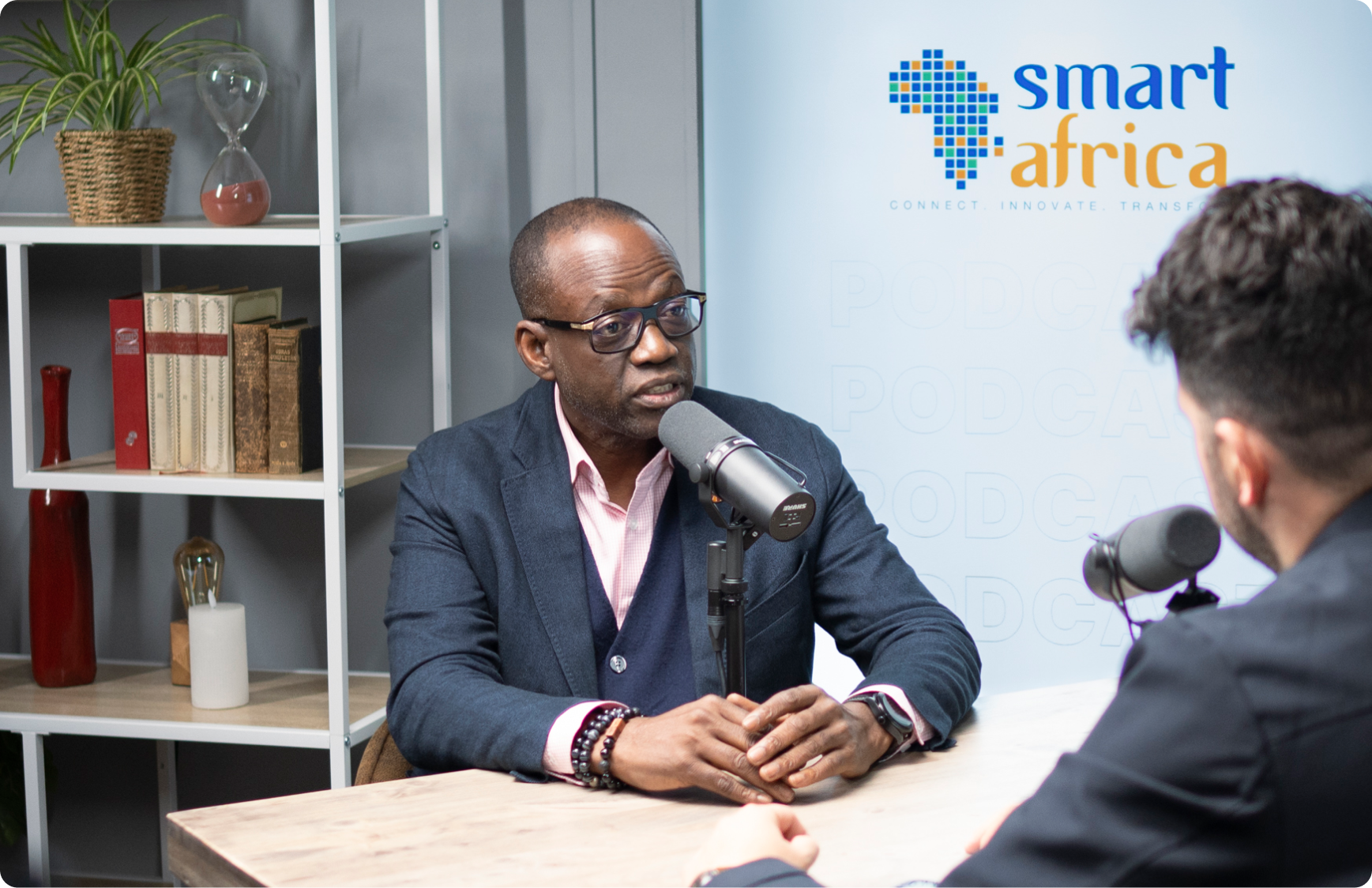
In this TechAfrica News podcast episode, Omar Diab, Regional Vice President of Sales for the Middle East and Africa at ST Engineering iDirect, sat down with Akim Benamara, Chief Editor and Founder of TechAfrica News, to unpack the structural shifts redefining connectivity across the continent.
The conversation moved seamlessly across satellite evolution, multi-orbit strategy, 5G expansion, AI-driven network management and new investment models. At its core, the discussion unpacked how technology, standards and partnerships are reshaping connectivity economics, and what it will take to bridge the rural access gap without sacrificing profitability or performance.
From interoperability and virtualization to service-driven models and ecosystem thinking, the exchange revealed the structural shifts quietly redefining Africa’s connectivity landscape.

- 00:29Africa’s Digital Momentum & Satellite’s Comeback
- 03:58ST Engineering iDirect’s Strategy in Africa: Multi-Orbit, 5G NTN & Intuition Platform
- 10:14AI as an Operational Game-Changer
- 14:55Satellite Enabling 5G in Rural Africa & The Unbound Model
- 21:32Partnership-Driven Innovation & Multi-Orbit Relevance
- 30:40The Future: Seamless Hybrid Networks & Broadcast Innovation
The Connectivity Gap: Cost, Scale and Smart Deployment
More than 300 million Africans still lack reliable connectivity. For Diab, the bottleneck is economic rather than technological. The challenge lies in reaching rural populations “in a way where it’s profitable for the connectivity providers as well as affordable for the general population.”
Satellite is no longer a last resort. With the rise of LEO constellations, it has become more accessible and accepted. What was once seen as “the expensive bulky add-on solution that’s absolutely necessary only if needed” is now central to expansion strategies.
Rather than viewing new entrants as threats, Diab frames them as part of a broader ecosystem that reinforces satellite’s relevance.
Africa Is Not a Country: The Case for Market Specificity
One of the more grounded observations in the discussion is Diab’s reminder that “Africa is not a country.” The continent is a mosaic of markets, each with distinct connectivity baselines, regulatory conditions, and vertical demands.
While LEOs help address base-level access, there remains strong demand for high-SLA, high-throughput connectivity in government, defense and enterprise verticals. ST Engineering iDirect positions itself in this space, focusing on multi-orbit capability and hybrid integration.
Intuition: Standardization, Virtualization and AI
Central to the company’s roadmap is its newly launched platform, Intuition. Built around interoperability, virtualization and AI, the platform aims to future-proof satellite networks.
Adopting standards such as 5G NTN and DIFI ensures seamless integration with core networks. “If you’re not doing that, you’re not relevant anymore in the connectivity space,” Diab says.
AI plays a practical role. Integrated into the network management system, it enables conversational reporting, anomaly detection, predictive maintenance and even digital twin simulations. “It streamlines a lot of the operations side of the network.”
The goal is not complexity for its own sake, but operational simplification.
5G Beyond the Cities: Hybrid and Multi-Orbit Backhaul
As African markets roll out 5G, satellite becomes critical beyond major cities. Hybrid and multi-orbit models allow operators to split traffic intelligently, keeping delay-sensitive services on GEO while offloading bulk data elsewhere. “At the end of the day, they’re getting a service on their device. It’s seamless.”
Investment models are evolving too. Through its “Unbound” approach, the company shifts from heavy CapEx to a usage-based OpEx structure, helping operators de-risk rural expansion. “We give the agility back.”
The future of connectivity in Africa, he suggests, will be seamless, standardized and increasingly ecosystem-driven.
“From a geo perspective, that segment isn’t going anywhere anytime soon. The penetration of LEOs has strengthened our position and highlighted the roles of each operator or constellation in the ecosystem. We see the complement between new market entrants and the traditional model, like terrestrial fiber and evolving GEOs driving high throughput. It all contributes to delivering a complete ecosystem, with multi-orbit playing an important role.”
– Omar Diab, Regional Vice President of Sales for the Middle East and Africa, ST Engineering iDirect
Partnership, Flexibility and the Push to Reduce Complexity
Partnership is at the heart of the company’s approach, enabling operators rather than going to market directly, and relying on close engagement and constant feedback. Collaborations with partners like Q-KON have tested AI-driven network analysis and predictive modelling in live environments, shaping product evolution. The move toward software-defined modems and virtualization allows faster adaptation to changing market needs without major hardware overhauls. Today, operators are seeking flexibility, efficiency, and reduced complexity to differentiate in their markets, and AI-driven automation is helping make networks simpler, smarter, and more adaptive.

Omar Diab is a global sales executive and Regional Vice President of Sales for the Middle East and Africa at ST Engineering iDirect. He has a strong track record of expanding into new markets, driving multi-million dollar revenue growth and leading high-performance international sales teams.
His expertise spans strategic market penetration, B2B sales and key account management, with experience securing large-scale recurring revenue and building partnerships with Fortune 500 companies and industry leaders. He is focused on scaling businesses, strengthening partner ecosystems and delivering sustained growth across complex markets.