Kenya Records KSh 931.8 Billion in Remittance Inflows, New KNBS Survey Shows
The report highlights the critical role remittances play in household welfare and economic stability.
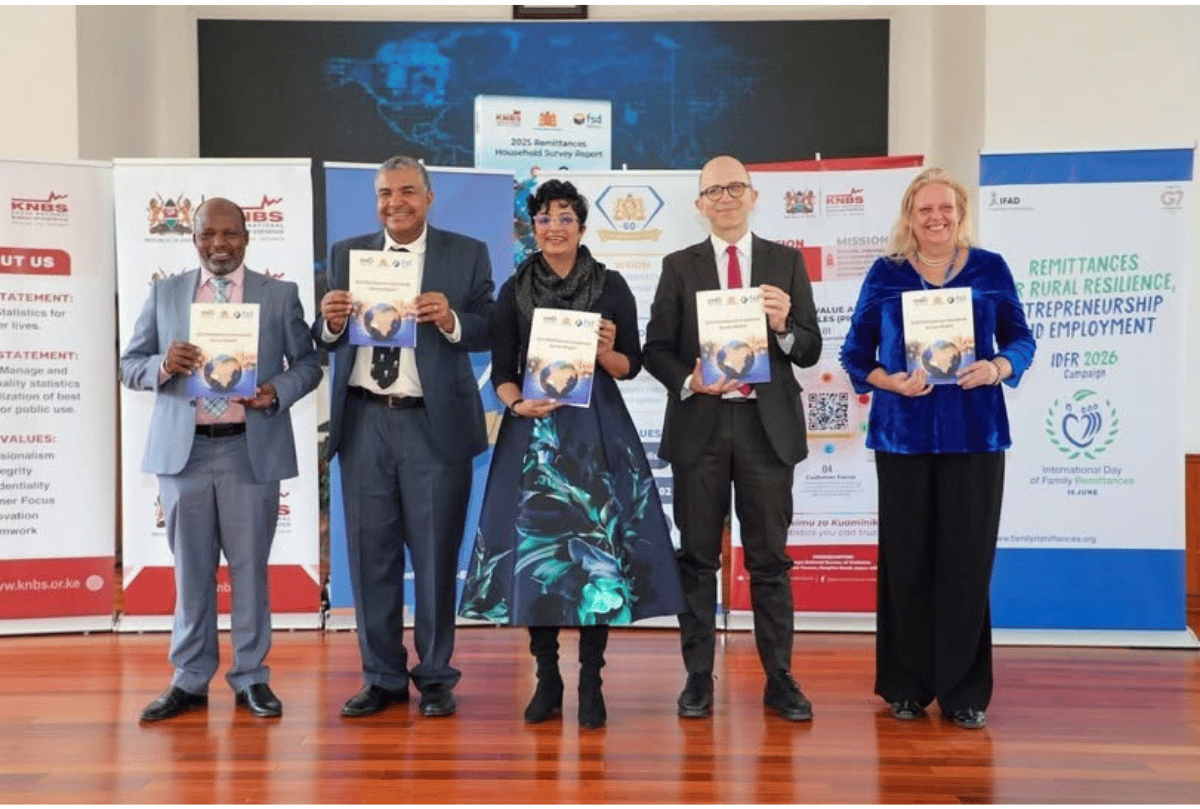
The 2025 Remittances Household Survey Report provides the first comprehensive nationwide assessment of remittance inflows and outflows in Kenya. The study was conducted by the Kenya National Bureau of Statistics (KNBS) in collaboration with the Central Bank of Kenya and Financial Sector Deepening Kenya (FSD Kenya), covering the period from June 2024 to May 2025. It fills critical data gaps in understanding how remittances support Kenyan households and the broader economy.
During the review period, Kenyan households received a total of KSh 931.8 billion in remittance inflows. Cash transfers dominated the inflows, accounting for 91% (KSh 848.4 billion), while in-kind transfers made up 9% (KSh 83.5 billion). The United States was the largest source of remittances, contributing 43.5% of total inflows, followed by Germany and Australia. Formal channels remained the primary mode of transfer, with banks and mobile money platforms facilitating more than 92% of all inflows.
The report highlights the critical role remittances play in household welfare and economic stability. About 42.3% of households reported remittances as a supplementary income source, 36.4% as additional income, and 22.3% as their main source of livelihood, underscoring their importance as a financial safety net for many families.
On the outflow side, Kenyan households sent KSh 40.5 billion abroad during the same period. A significant portion of these transfers—more than two-thirds—was directed toward supporting students studying overseas, reflecting the role of remittances in financing education and human capital development. Cash transfers accounted for 89.5% of outflows, while in-kind transfers made up 10.5%.
The survey also reveals important socio-demographic patterns. Rural households represent the majority of both remittance senders and recipients. Additionally, education levels influence the form of remittances received, with urban and more educated households primarily receiving cash transfers, while rural and less educated households are more likely to receive in-kind support.
Financial inclusion remains closely linked to remittance activity, with 82.5% of recipients using mobile money accounts and 55.4% holding bank accounts. However, high transaction costs were identified as the most significant challenge affecting both sending and receiving remittances.
The report recommends policies aimed at reducing transaction costs, expanding access to affordable formal transfer channels, and leveraging remittances for productive investments in education, health, and sustainable development. It also emphasizes strengthening diaspora engagement in line with Kenya’s Vision 2030 and the Diaspora Policy 2024.