Huawei Unveils Atlas 960E SuperPoD for 10-Trillion-Parameter AI Models
Huawei's AI strategy is centered on computing power, with a focus on monetizing hardware.
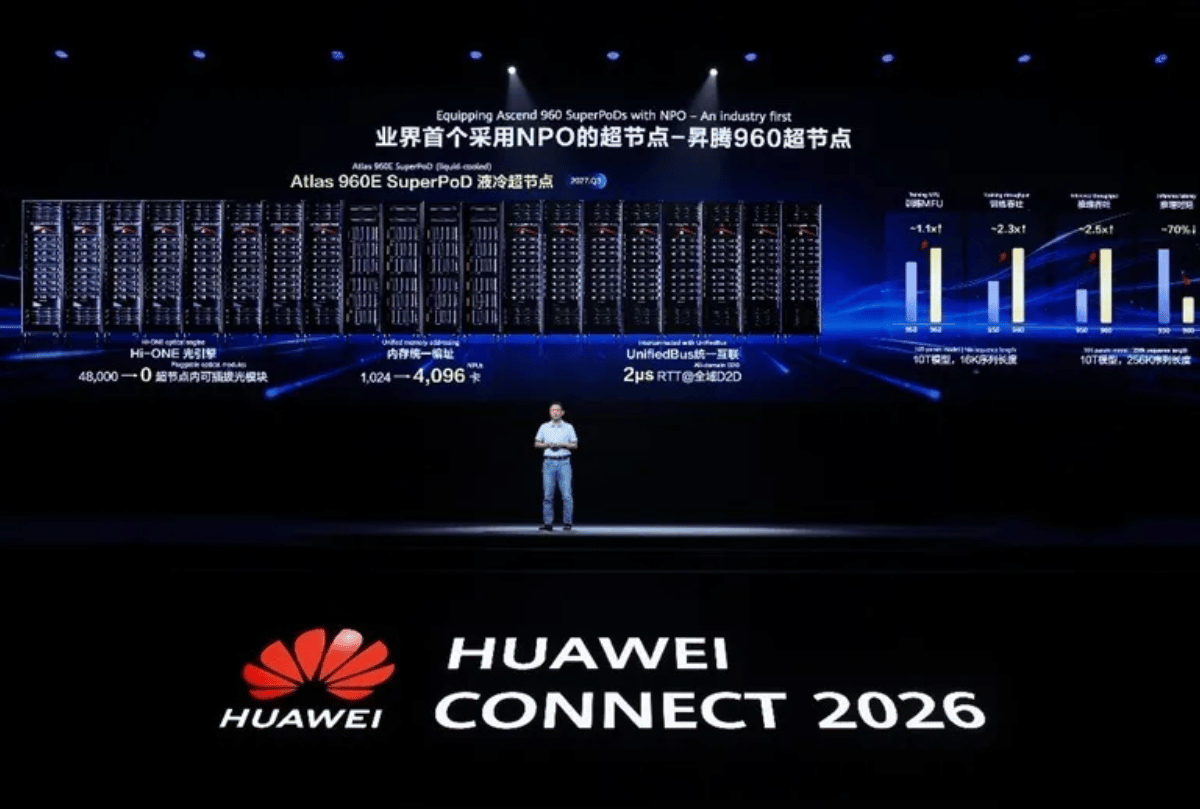
HUAWEI CONNECT 2026 kicked off in Shanghai. David Wang, Deputy Chairman of the Board and Rotating Chairman at Huawei, delivered a keynote speech titled Advancing the Agentic World, Building a Solid Silicon Foundation. In his speech, Wang launched the industry’s first NPO-based SuperPoD – the Atlas 960E SuperPoD – to accelerate training and inference for 10-trillion-parameter models.
Huawei’s AI strategy is centered on computing power, with a focus on monetizing hardware. The company is committed to building out AI infrastructure – the silicon foundation for the intelligent world, and honing its competitive edge through systems and architectural innovation. Centering these efforts on SuperPoDs and SuperClusters, Huawei aims to build a solid computing foundation, go open source and open system to build out computing ecosystems, and offer a new option for the world.
As foundation models approach 10 trillion parameters, SuperPoDs are the go-to choice for AI infrastructure buildout. Huawei’s SuperPoD design approach centers on connecting all cluster components under a single protocol with peer-to-peer interconnect, supporting cross-physical-server memory access, and adopting short-reach copper alongside long-reach optics. Through sustained system-level innovation, Huawei has applied its years of expertise in optical technology to its SuperPoDs, introducing the world’s first mass-produced NPO optical engine – Hi-ONE. This product delivers industry-leading transmission capacity at 7.2 Tbit/s, and is currently the industry’s only NPO with a built-in light source.
At the event, Wang unveiled the Atlas 960E SuperPoD powered by UnifiedBus and Hi-ONE. As the industry’s first NPO-based SuperPoD, the Atlas 960E SuperPoD features an advanced orthogonal architecture and a fully liquid-cooled design. With unified memory addressing enabled by UnifiedBus, a single SuperPoD can scale to 4,096 NPUs, delivering 8 EFLOPS at FP8 precision and 16 EFLOPS at FP4 precision. By integrating 5,500 Hi-ONE units, this SuperPoD doesn’t need the 48,000 800G optical modules that would traditionally be required to connect all the NPUs. This cuts power consumption by over 550 kilowatts, while doubling the system’s fault-free operating time, achieving 99.8% system availability. All told, the system greatly accelerates innovation in training and inference for frontier models.
Huawei has also applied the SuperPoD architecture to general-purpose computing systems, resulting in products like its fully upgraded TaiShan 950 SuperPoD. Powered by UnifiedBus all-optical networking, the new SuperPoD supports up to 4,096 nodes with a unified memory pool of up to 256 TB. This enables higher-density agent sandboxes, faster sandbox startup, and improved agent vector search performance. Huawei has also launched OceanStor M900 – a UnifiedBus-powered context memory storage cluster that supports direct one-hop access and provides a petabyte-scale KV cache for the L3.5 layer.
With the UnifiedBus network or RoCE, multiple Atlas 960E SuperPoDs can be connected to build a larger SuperCluster. With a two-tier, four-plane Clos architecture, the SuperCluster can interconnect up to 512,000 NPUs. And when combined with a multi-rail topology, this cluster can support up to one million NPUs.
Wang noted that one of Huawei’s core strategies is going open source and open system to build out computing ecosystems. CANN is now open source and openly accessible and has moved into sustained, community-driven open-source development. This has brought the platform from usable to user-friendly, marking a new inflection point for the Ascend ecosystem.
“At Huawei, we are committed to building powerful AI infrastructure and going open source and open system to build out computing ecosystems. We will continue to support native training for mainstream foundation models on Ascend and actively embrace a wide range of models and applications. Together, let’s lead the charge into the intelligent world.”
– David Wang, Deputy Chairman of the Board and Rotating Chairman, Huawei
Themed Advancing the Agentic World, HUAWEI CONNECT 2026 will delve into AI across three dimensions: strategy, technology, and ecosystems. You can expect an in-depth look at our latest strategic initiatives, and we’ll also be unveiling our all-new digital and intelligent infrastructure products, scenario-specific solutions for industries, and development tools. The event will run from September 17 to 19 at the Shanghai World Expo Exhibition & Convention Center and Shanghai Expo Center. For more information, please visit HUAWEI CONNECT 2026 online at www.huawei.com/en/events/huaweiconnect