Building for the Next Decade: How Openserve Plans to Drive Carrier-Grade Fibre into Rural and Peri-Urban South Africa
The fibre conversation often focuses on homes and businesses, but there is another layer that quietly determines how well a country stays connected. It is the layer that routes traffic between operators, links national networks to international hubs, and supports the digital platforms people rely on every day.
So the real question is this: what does fibre progress look like when viewed from the carrier and global interconnect side of the market? How are backbone networks evolving as demand for capacity, cloud services, and cross-border connectivity rises? And what must change to ensure these wholesale networks can carry the weight of future 5G, IoT, and edge ecosystems?
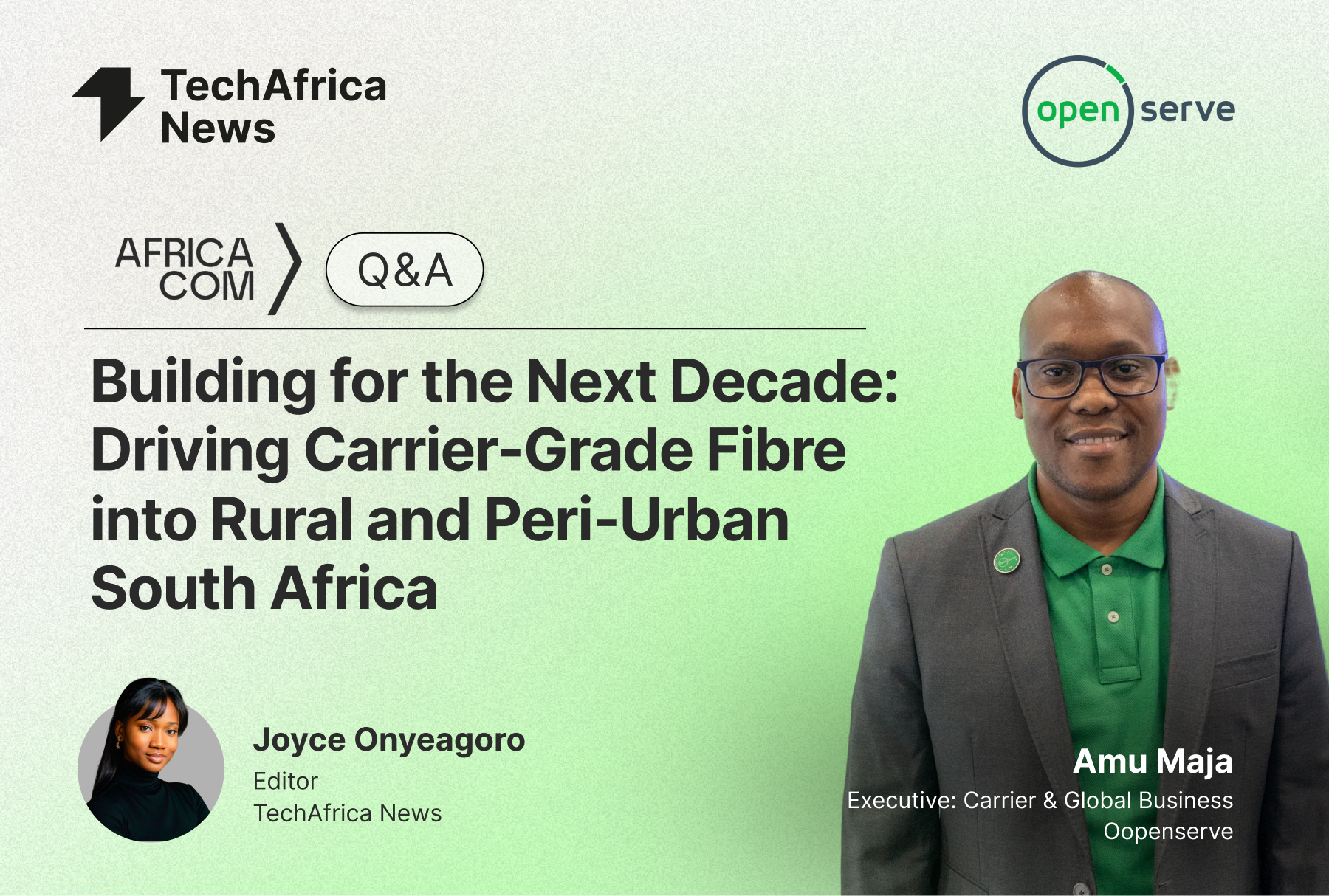
To explore these questions, TechAfrica News Senior Editor, Joyce Onyeagoro, caught up with Amu Maja, Executive: Carrier and Global Business at Openserve, during AfricaCom 2025. He unpacked the shifts of the past five years, the challenges that still slow fibre deployment, and the practical steps the industry should take now to strengthen South Africa’s digital backbone for the decade ahead.
When we talk about fibre as the digital backbone, what progress stands out most in your respective markets over the last 3–5 years – and where do you believe the next major push must happen?
So for us, the key part for me is what happened five years ago when we had the pandemic and everyone was forced to study and work from home. What that did was create a period where fibre connectivity played a crucial role in providing real accessibility to the internet. It was also a moment where the demand for fibre coincided with the ramping up of fibre investments by fibre network operators.
But it still did not satisfy the needs of the country. There were parts of South Africa that did not have fibre connectivity. Some communities had mobile options, some had satellite options, but those tended to be more expensive for the type of content required for the platforms they were using.
Whether it was dialing in to work and having visual representation on their Teams or their Google Meets, it created an issue. That is where we saw that the next growth of fibre rollout is in the peri urban areas and the rural areas. That is why we are looking at how we provide services for that community.
How do we provide connectivity for that community in anticipation of expanding activity in that community? And also, if there is another pandemic, can they work from home? Can they study from home? That is the chase we are on for the next five years.
In that context, does this come down to last mile connectivity?
Last mile connectivity is a priority. That is where you touch the family and the community. At a carrier level, by default, we support our carriers in that front as well.
As we connect the carriers, we connect the homes. As we connect mobile operators with their towers, we connect the homes. As we connect the Department of Home Affairs, the police service, and the health centers, we connect the homes.
So the home will always be a consideration for us. We do not want to connect a government facility and forget about the community around that government facility, because at times the government will decide to digitize booking appointments at the facilities.
But if there is no internet, it becomes a wasteful exercise.
South Africa leads in terrestrial fibre footprint. How is Openserve evolving wholesale models to extend fibre further into peri-urban and rural zones, where commercial returns are slower?
One of the key elements we focused on was a balanced network rollout strategy. Normally, we would roll out fiber in urban, highly densified areas first. Then we started selecting and targeting rural areas where rollout was essential. The objectives for these two areas are slightly different.
In urban areas, the goal is commercial return and converting customers as quickly as possible. In rural areas, the focus is on what we can achieve in terms of digital inclusion, societal impact, and creating economic opportunities for the community.
When we evaluate our business case, we combine these two perspectives. In rural areas, we understand it will take time and that we need to stimulate the community further. In urban areas, returns are easier, and some of that revenue is reinvested into rural rollout. Another important element is affordability. That is when we explored a prepaid wholesale model, creating a system where communities can access fiber services when they need it, whether for a day, a week, or a weekend. Some people live in the city but visit rural homes on weekends, and this model allows them to connect temporarily. It ensures that everyone, from students to older members of the community, can connect when they have the means, linking them to the wider world.
We also focused on awareness. Rolling out infrastructure is one thing, but how do communities know it is available? That led us to engage with local media, including newspapers, radio stations, and branded delivery scooters and bikes. We participate in community health conversations and other local events to ensure people understand that fiber is here, what it does, and how it differs from Wi-Fi. Using familiar terms like Wi-Fi helps draw people in and ensures they grasp the value of what we are providing.
In many countries, fibre deployment costs are doubled due to municipal fees, long permitting cycles, and physical infrastructure risks. What needs to shift – policy, incentives or operational strategy?
For us, it is a combination of three elements. From a policy perspective, a change is needed, particularly on a national-level way-leave reform. The goal is to create a standardized and transparent framework. Currently, each municipality has its own rules, charging different costs for way-leaves and causing delays. A national framework would ensure consistency in application processes, lead times, and cost structures. Ideally, the cost should reflect only what is required to process applications and grant permissions, which is the most reasonable approach from our perspective.
Another policy area is trenching. We have considered the possibility of “dig once” legislation. Governments undertake projects for roads, water, and energy infrastructure. Policies could mandate that these projects include ducts that can be used for fiber, which would create additional fiber availability at lower incremental costs. This is one area where government involvement can make a significant difference.
Incentives are the second element. Governments can provide subsidies for targeted areas, particularly rural or underserved urban communities, to stimulate investment. Tax incentives, such as lower rates or temporary relief for these projects, can also encourage operators to enter areas where immediate returns are limited. Even if the business case is long term, operators can plan for eventual returns, making investment feasible.
The third element is operational strategy. Beyond policy and incentives, fiber network operators must actively collaborate. This includes sharing infrastructure, coordinating trenching projects, and aligning initiatives to reduce duplication and cost. Partnerships with utility providers are also critical. Existing infrastructure, such as railway lines, power lines, and gas pipelines, can be leveraged for fiber deployment. These partnerships reduce provisioning costs, improve affordability, and expand access, particularly in rural areas.
If we look forward 5–7 years, what must happen now so that fibre can support the scale of 5G, edge data centers, nationwide IoT, and city-level digital services? Give one practical, high-impact action your market can take in 2025 to accelerate fibre scale.
“For me, I look at two parts of the world. There is no single answer that covers everything. In urban and metro areas, facilities are already available. The focus there is on creating scale to support AI, cloud services, and all the digital innovations taking place. It is essential to ensure traffic flows efficiently and to maintain strong partnerships with cloud providers and AI platforms, many of which require localization. In rural and semi-rural areas, the approach is different. Fiber deployment can be simplified compared to metro areas. The goal is inclusion and providing access to these communities while offering flexibility in the value proposition.”
– Amu Maja, Executive: Carrier and Global Business, Openserve
Deploying infrastructure cheaply but charging high prices would not make sense. That is why the prepaid offering works well. It allows someone in the community to purchase the standard product available in urban areas if they can afford it. If not, there is a product for temporary use – a service that can be activated for a day, a weekend, three days, or a week. For example, someone could use it to download content for Netflix over a week, then pause and reconnect a month later.
The objective is to provide the right flexibility. Mobile services already operate this way, so there is no reason fiber should not follow the same model.