Why “Made in Africa” Smartphones Keep Losing to Assembly
Governments across Sub-Saharan Africa want to reduce dependence on imported devices, create jobs and protect smartphone prices from foreign exchange volatility. But building a complete smartphone manufacturing industry requires an industrial ecosystem and capital scale that the region currently lacks. In practice, trying to produce hardware components in-country isolates factory operators from established global supply networks.
The difference is showing up across the market. Some ambitious attempts to build African-owned smartphone manufacturers have struggled to compete with cheaper imports. Meanwhile, assembly partnerships in Kenya and Egypt are expanding production by working with established global manufacturers, and Transsion continues to dominate the African smartphone market by focusing on affordability, distribution and products designed for local consumers.
The question, then, may not be whether Africa should make more phones at home. It is whether full manufacturing is the right place to start.
This #TechTalkThursday examines why Africa’s smartphone manufacturing ambitions have collided with the economics of the global device industry, what assembly-led models are doing differently, and whether the continent’s most realistic path to a local device industry looks very different from the “Made in Africa” vision.
The Forex Illusion: Why Local Hardware Cannot Escape Dollar-Denominated Supply Chains
Building consumer hardware competitively requires multi-million-unit annual runs—a threshold Asian manufacturing hubs hit with ease due to decades of deep industrial clustering. Sub-Saharan Africa’s market, by contrast, remains fragmented across 54 sovereign borders, each with distinct regulatory hurdles, tariff schedules, and currency environments that prevent manufacturers from pooling regional demand.
This inability to aggregate scale creates an immediate cost deficit. According to Rwandan government data presented by ICT Minister Paula Ingabire, making or assembling a device locally carries an immediate 5% cost penalty over importing finished units from Asian hubs. From there, the economics only get worse: local plants must absorb grid instability and port congestion while remaining completely dependent on imported chipsets, screens, and batteries.
The Currency Trap
Policymakers frequently present local manufacturing as an antidote to foreign exchange volatility. This logic was articulated by Chief Idris Ibikunle Olorunnimbe, Chairman of the Nigerian Communications Commission, during a Digital Africa Summit roundtable in Shanghai :
“We will not solve affordability at scale by importing our way out of it. We have to make more of the phone here, at home. The logic is simple. When a device is built in Nigeria, more of its cost is denominated in Naira. It stops rising and falling with every move in forex. That is how you take the volatility out of the price, bring the price down, and keep it down.”
— Chief Idris Ibikunle Olorunnimbe, Chairman, Nigerian Communications Commission
While attractive on paper, this premise collapses against component economics. Because no high-spec microelectronics are fabricated domestically, factory operators remain entirely exposed to the dollar-denominated supply chain. As Nitesh Singh, Managing Director for Communications, Media and Technology at Accenture, noted on the TechAfrica News Podcast:
“FX is a big issue in Africa. It’s very volatile. You look at the supply chain of all the equipment coming in, it’s not manufactured in Africa—no smart devices, no radio equipment… all of that costs money and time. All those things are problems that need to be solved, and the regulatory bodies are not helping.”
— Nitesh Singh, Managing Director for Communications, Media and Technology, Accenture
When a factory buys every active component in US Dollars, local currency pricing is a myth. Currency depreciation simply inflates the cost of imported knock-down kits, erasing any theoretical price stability.
The Protectionism Blindspot
To reach the volume threshold where local overhead is neutralized, hardware ventures must absorb steep losses for years. When market forces prove too severe, governments often default to protective import tariffs to force price parity.
Protectionism, however, shifts the burden directly onto consumers in price-sensitive markets without fixing underlying supply chain costs. It risks trade retaliation and insulates domestic plants from global efficiency standards. Rather than fostering a competitive sector, tariffs create high-cost local monopolies that survive only as long as the policy wall stays up.
How Assembly and Carrier Partnerships are Rewriting Device Economics
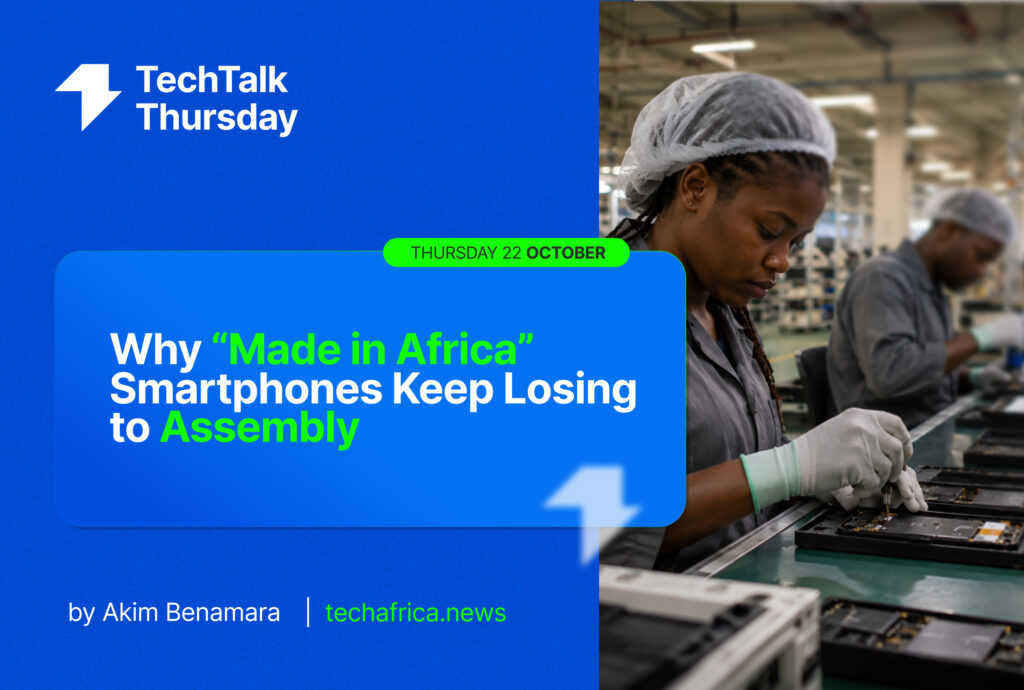
Where full-manufacturing mandates have crashed against global scale, a pragmatic strategy is succeeding. Instead of trying to forge silicon or component sub-boards domestically, markets like Kenya and Egypt are using semi-knocked-down (SKD) and completely-knocked-down (CKD) assembly to build domestic technical capacity, create thousands of jobs, and drastically lower import bills.
The Volume Blueprint: Kenya’s Operator-Led Model
Kenya’s approach trades nationalistic posturing for distribution power. In late 2023, East Africa Device Assembly Kenya (EADAK) , a joint venture between Safaricom, Jamii Telecommunications, and Chinese industrial partners, opened an assembly plant in Athi River. Instead of pursuing high-margin, flagship specifications, EADAK focused strictly on volume logistics: producing entry-level 4G smartphones near the $50 price point.
The key to EADAK’s survival is its direct integration with telecom operators. By embedding device assembly into Safaricom’s ecosystem, EADAK secured instant nationwide distribution and embedded consumer financing. Designed for an annual capacity of three million units, the facility surpassed one million devices produced by late 2024 and assembled another 700,000 units in the financial year ending March 2026. The devices are assembled locally, but their cost structure remains tightly anchored to global supply chain efficiencies.
The OEM Partnership Hub: Egypt’s Industrial Scale
Egypt has scaled this concept into a regional manufacturing strategy by partnering directly with established global hardware brands. Today, approximately 10 domestic factories assemble devices for Samsung, Oppo, Xiaomi, Vivo, and Nokia. Samsung initiated this trend at its Beni Suef plant with the Galaxy A13, while Oppo and Vivo committed substantial capital toward local production facilities.
By enforcing policy frameworks around local value-added requirements—covering domestic packaging, sub-assembly, quality testing, and local logistics—Egypt’s installed assembly capacity reached 20 million units annually by 2026. Industry data shows this push cut finished-phone imports by 97%, training a skilled technical workforce without demanding local chip fabrication.
The Automotive Lesson
This pragmatic shift mirrors the global automotive industry, where regional hubs assemble vehicles from imported knock-down kits rather than manufacturing engine blocks and transmissions on site. As Accenture’s Nitesh Singh noted:
“If we have smartphone device manufacturers in Africa, the same way we’re building cars, I think that will help with the supply chain of equipment through the continent and build skills and so many other benefits to it. But we need the high-tech smartphone manufacturers, the chipset manufacturers to finally make good on their promises of really landing in Africa. That’s what government should be doing: attracting them in.”
— Nitesh Singh, Managing Director for Communications, Media and Technology, Accenture
Assembly allows African nations to capture real economic ground where it matters most: driving down consumer device costs, retaining local value, and easing foreign exchange pressure—all while working within global supply chain realities rather than resisting them.
State Backing vs. Unit Economics: The Industrial Policy Gap in Device Production
If full local manufacturing consistently fails on device economics, why do African policymakers continue to fund and promote it? The answer lies in the immediacy of policy objectives: driving domestic job creation, reducing foreign exchange outflow, and fostering long-term technological capability.
This policy push was evident during the Shanghai roundtable, where Nigerian Communications Commission (NCC) Chairman Chief Idris Ibikunle Olorunnimbe emphasized quality parity and state backing as central to Nigeria’s device strategy:
“The target is not a locally made phone that asks consumers to settle for less. It is a phone that matches imported devices on quality and beats them on price… Any manufacturer willing to commit to building a smartphone factory in Nigeria—with construction beginning before November 2026—will receive full government backing and operational incentives.”
— Chief Idris Ibikunle Olorunnimbe, Chairman, Nigerian Communications Commission
While industry stakeholders like GSMA welcomed the regulatory commitment, state incentives cannot override global supply chain mechanics. Subsidies, tax grace periods, and state procurement commitments only mask uncompetitive production costs. Once those protections expire, facilities built on policy mandates rather than scale inevitably collapse.
The policy mismatch lies in trying to sponsor standalone hardware projects against established global scale, rather than enticing tier-one vendors to land regional assembly capacity. Until industrial policy shifts from subsidizing uncompetitive fabrication to enabling scalable assembly and supply logistics, governments risk repeating the costly cycles of the past decade.
The Right Battle: Winning on Distribution, Assembly, and Access
Chasing vertically integrated device manufacturing is the wrong industrial battle for Sub-Saharan Africa. Without local supply chains or multi-million-unit scale, forced domestic production simply passes unsustainable cost premiums onto the consumers who need affordability most.
True digital sovereignty will not come from fabricating microchips domestically at triple the global market price. It comes from mastering what actually expands access: regional assembly, operator partnerships, and embedded device financing—the pragmatic blueprint already working in Kenya and Egypt.
The remaining question is whether African governments will embrace this pragmatic assembly model or continue funding “Made in Africa” projects built to fail against global competition.