Tax Reforms vs Local Assembly: Which Path Truly Leads to Africa’s $30 Smartphone?
Africa’s digital transformation is now gated by one object: the smartphone. It enables mobile money, digital identity, e-government services, health applications, and education access, yet it remains the clearest marker of digital exclusion. According to the GSMA, 64% of Africans living under mobile broadband coverage still do not use the internet. The network exists, but the device is unaffordable.
Affordability is the steepest barrier. In Sub-Saharan Africa, the median cost of an entry-level smartphone rose from $38 to $39 in 2024, pushing the cost burden to 26% of monthly GDP per capita, compared with 16% in other low- and middle-income countries. For the poorest 20%, a smartphone consumes 87% of monthly income.
Device ownership remains low. Only 24% of Africans owned a smartphone in 2024, compared to 56% globally.
In response, governments, operators, and multilateral institutions have rallied around a single goal: a sub-$40 smartphone, with a long-term ambition of $30. This target is more than symbolic. Achieving it is essential to migrating users off 2G/3G networks, unlocking spectrum efficiency, and accelerating digital inclusion.
Two policy approaches dominate the debate: Fiscal reform ( reducing or removing taxes on entry-level devices), and Local assembly (building smartphone plants to cut import reliance and retail prices).
Both are politically appealing. Only one offers near-term impact. The question is which can realistically deliver a $30 device – and how soon. This #TechTalkThursday article dives into that.
The Role of Fiscal Policy: How Taxes Inflate Smartphone Prices
Across Africa, taxes and duties are the single most distorting factor in smartphone pricing. GSMA fiscal analysis across 35 markets shows consumers face an average 33% combined tax burden on smartphones (VAT plus customs duty). In some cases, the burden is prohibitive:
- Côte d’Ivoire: 50% total tax (32% duty + 18% VAT)
- Chad: 48%
- Sierra Leone: 45%
This tax structure is deeply regressive. A $50 phone from Shenzhen routinely retails for $90–$110 in African markets, reflecting an 80–120% markup after duties, logistics, customs delays, and distribution costs.
These inflated prices reinforce the usage gap. GSMA data shows smartphone affordability is the most cited barrier to mobile internet adoption across the continent. In rural areas, prices rise further due to last-mile distribution inefficiencies.
The consequence is systemic: Africa, the region with the highest smartphone cost relative to income, hosts 33% of the world’s unconnected population.
Fiscal policy is therefore more than an economic instrument. It is the fastest, most predictable accelerator of digital inclusion available to African policymakers.
“The issues of access in terms of affordability are also crucial. A number of our people grapple with the issues, whether it is a smartphone or food on the table, and yet that choice must not be there. In terms of the gains that we see, individuals that have access to smartphones and are able to use this creatively participate quite well in the economy, and so driving down prices for devices is something that our governments need to come to terms with so that people are able to afford terminals in a much easier way than has been the case before.”
– John Omo, Secretary General , the African Telecommunications Union (ATU)

The South Africa Experiment: A Case Study in Immediate Impact
South Africa offers one of the clearest proofs of fiscal reform’s effect. In 2025, the government removed the luxury excise duty on smartphones priced under ZAR 2,500 (≈$143). The result was immediate: a 49% surge in sales within that price band, with no new factories, supply-chain redesign, or multi-year lead times. Prices fell, and consumers responded instantly.
The change did more than boost retail numbers. Distribution channels reported a notable shift from feature phones to smartphones, as consumers realised that the same budget that once limited them to basic devices could now secure a capable entry-level smartphone. Between March and July, the share of smartphones priced under ZAR 2,000 grew from 21 percent to 23 percent, while feature-phone sales declined. Consumers moved toward better devices because affordability finally aligned with their aspirations.
The policy outcome matched the intent of South Africa’s leadership. Honorable Minister Solly Malatsi, the Minister of Communications and Digital Technologies, explained this during a fireside chat at the launch of the Accelerating Smartphone Adoption in Africa report at the Digital Africa Summit in Cape Town. He noted that the goal was not only to increase sales but to widen digital access across the country.
He stated that taxation should function as an enabler rather than a barrier, especially in a world where smart devices support daily activity, economic participation, and learning. He also pointed out that affordability is the first gateway to inclusion as countries prepare for an AI driven future built on cloud services, 4G and 5G networks, and advanced digital platforms. Without affordable devices, consumers, enterprises, and entire value chains remain anchored in 2G and 3G environments.
“Let us also rethink the issue of VAT on smart devices and approach it in a way that allows us to unlock the true potential of this sector as a major economic enabler. We cannot ignore the reality that this sector has become the bedrock of many others. The opportunity cost is also important for our revenue collection teams to consider. When more people participate in e-commerce, online banking, and e-learning, the increase in overall economic activity far outweighs any revenue that may be lost through such tax adjustments.”
– Honorable Minister Solly Malatsi, the Minister of Communications and Digital Technologies.
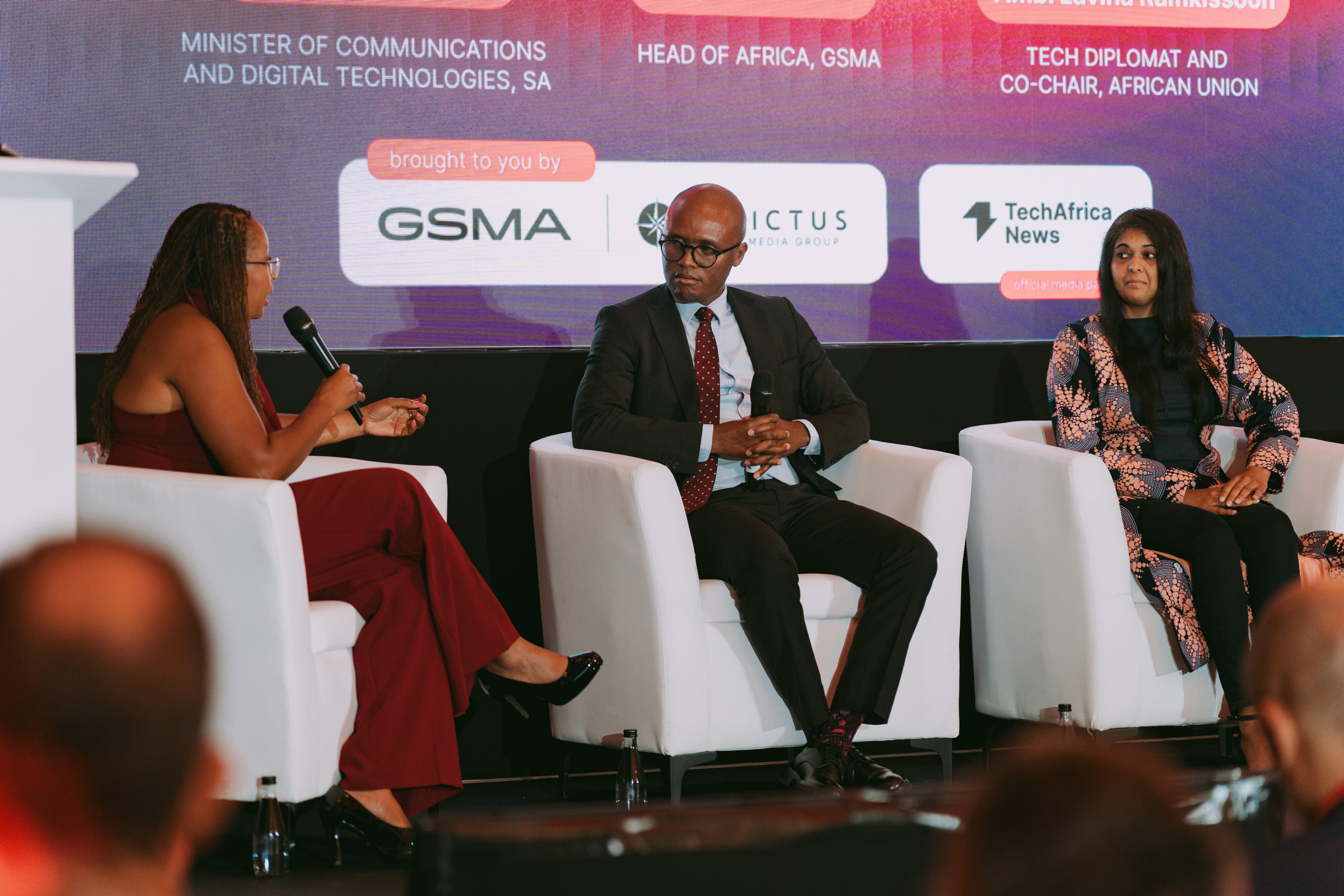
Ambassador Lavina Ramkissoon who also contributed to the conversation, stressed the importance of reviewing outdated ICT and digital policies across the continent to ensure they support device affordability, investment, and long term readiness. She noted that connectivity should be treated as a human right and that device affordability is the first gateway to achieving this.
By contrast, Rwanda’s reintroduction of VAT on smartphones slowed adoption, underscoring the direct link between taxation and usage.
For operators, fiscal reform is not merely a retail strategy. It accelerates migration from 2G/3G to 4G/5G. Only 44% of mobile internet users in Sub-Saharan Africa access the internet on 4G or 5G devices, creating a bottleneck for legacy network sunset plans.
South Africa demonstrates a simple truth: no other policy instrument works as fast or as predictably as tax reduction to stimulate smartphone penetration.
“We always need to balance this equation to provide people with the best technology in the most efficient way, while continuing to grow the market and connect more people to the network.”
– Hassan Jaber, CEO, Axian Telecom

The Promise and Failure of Local Assembly: A Hard Reality Check
“Made in Africa” smartphones carry strong political appeal, promising industrialisation, jobs, and technological sovereignty. Yet GSMA’s 2025 findings are clear: local assembly has not translated into lower retail prices in most markets.
The reasons are structural. Most assembly plants rely on CKD or SKD kits imported from Asia, meaning core components such as chipsets, screens, batteries, and PCBs are still brought in from abroad. This reliance keeps import-related costs, including shipping and customs duties, high. Energy costs in many markets are also substantial, and there is a limited pool of skilled labour for electronics assembly.
In addition to that, the absence of economies of scale, which are essential for achieving global smartphone pricing, makes it difficult for local producers to compete. High-profile failures illustrate the challenge. Mara Phones, launched in Rwanda and South Africa with ambitions of producing 1.2 million devices annually, collapsed due to weak demand, high production costs, and an inability to match import prices. Egypt is sometimes cited as a relative success, benefiting from a large domestic market, established electronics manufacturing capabilities, and scale, though imported components still dominate its production.
While local assembly can help build industrial capacity, under current economic realities it is unlikely to deliver ultra-low-cost smartphones.
The Sub-$30 Smartphone Target: Ambition Meets Arithmetic
A sub-$30 smartphone remains a compelling goal. GSMA modelling estimates that closing Africa’s usage gap by 2030 could contribute $700 billion to GDP.
Yet the economics are unforgiving. The bill of materials for a basic 4G smartphone; chipset, display, battery, memory, casing, antennas, assembly, licensing , totals $20–$25 before logistics, duties, distribution, and retail margins. Even rare $30 devices, like the Orange-Google Sanza Touch, required heavy subsidies, Android Go licensing, and large-scale procurement.
GSMA concludes: Africa will not reach a $30 smartphone through local manufacturing alone. The path lies in:
- Eliminating taxes and duties on sub-$100 devices
- Large, multi-country procurement to achieve scale
- Cloud-based devices that offload compute costs
- Financing mechanisms such as PAYG or airtime-based credit
- Formalising the pre-owned market to recycle imported devices
To sharpen the push for affordability, GSMA has joined forces with six of Africa’s largest mobile operators – Airtel, Axian Telecom, Ethio Telecom, MTN, Orange and Vodacom, under the banner of the GSMA Handset Affordability Coalition. Launched in 2025 at MWC Kigali, the coalition sets out a clear plan. It proposes baseline hardware requirements for entry‑level 4G smartphones (memory, RAM, display, battery, and related features) to ensure that low‑cost devices are still functional and durable.
In a recent interview at MWC Kigali 2025, Angela Wamola highlighted the coalition’s strategy:
“We are focusing on devices priced at $40 and below for the majority. These are entry-level smartphones, not feature phones, designed with fit-for-purpose specifications that meet quality-of-service requirements while remaining affordable for underserved populations. At the same time, we are calling for bold actions from African states to follow South Africa’s example in removing the 9% ad valorem luxury tax on devices priced under $150. This approach boosts device affordability and opens opportunities to bundle data services, creating viable commercial propositions for customers.”
-Angela Wamola, Head of Africa, GSMA
“Access to a smartphone is not a luxury – it is a lifeline to essential services, income opportunities and participation in the digital economy. By uniting around a shared vision for affordable 4G devices, Africa’s leading operators and the GSMA are sending a powerful signal to manufacturers and policymakers..”
–Vivek Badrinath, Director General, GSMA
Beyond hardware standards, the coalition issues a call to African governments to remove taxes and duties on smartphones priced under US $100 — a move intended to sharply lower the retail price of devices for end users.
This combined approach reflects a strategic pathway toward sub‑$30 or sub‑$40 smartphones across the continent. Under this framework, low-cost ownership becomes a realistic target, not a distant ideal.
The sub-$30 smartphone is achievable, but only through coordinated policy and market innovation, not assembly lines.
The Path Forward – Policy, Not Plants
Evidence is clear: Africa cannot assemble its way to a sub-$30 smartphone in the near term. Local assembly holds long-term industrial value but will not resolve the affordability crisis within five years.
The only tool with immediate, proven impact is fiscal reform. GSMA analysis shows that removing taxes on smartphones under $100 can cut retail prices by up to 50% in some markets. Combined with innovative financing, cloud-phone models, and a structured pre-owned ecosystem, Africa can realistically reach the sub-$40, and eventually $30 price point.
The truth is simple, and backed by data: Africa’s digital revolution will be unlocked by policy, not production.