How Ownership Structure and Right-of-Way Execution Will Decide the Real Impact of Nigeria’s $2 Billion Fibre Buildout
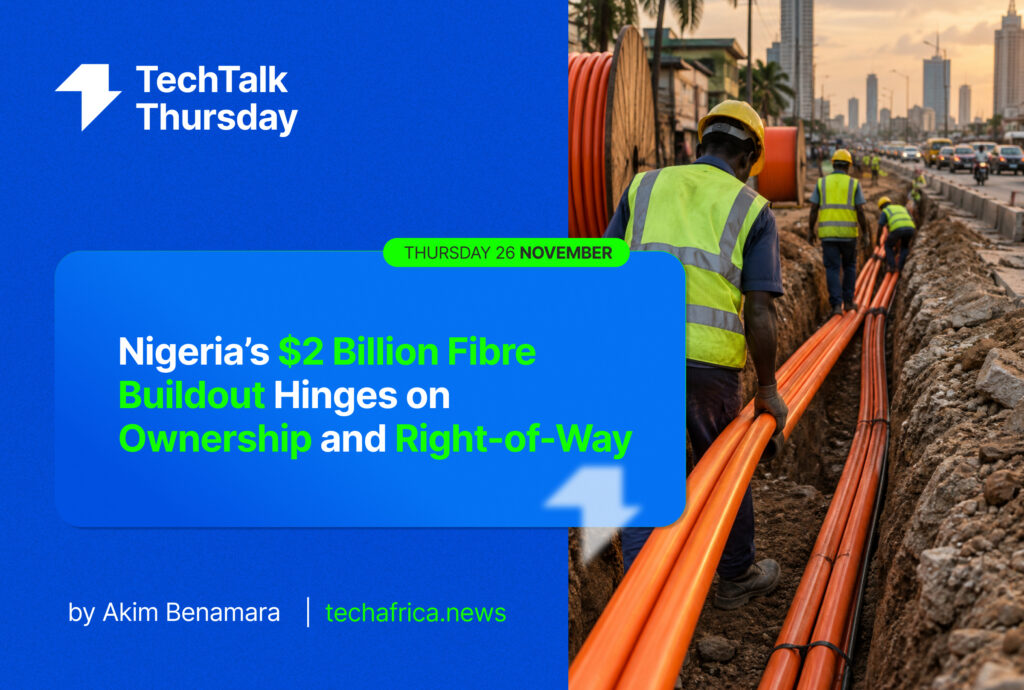
Nigeria has incorporated Bridge Open Access, secured roughly $800 million in sovereign financing from the World Bank, African Development Bank, and European Bank for Reconstruction and Development, and set a compressed timeline targeting physical rollout from October 2026 toward completion by 2028 . The initiative plans to add approximately 90,000 kilometres of open-access fibre, expanding the national backbone from roughly 35,000 kilometres to 125,000 kilometres while connecting public institutions and all 774 local government areas.
While the infrastructure ambition is clear, a fundamental market question remains: will laying 90,000 kilometres of new cable close Nigeria’s persistent internet usage gap, or simply build wholesale capacity above the exact same retail affordability barriers that already limit adoption?
This edition of #TechTalkThursday examines what Nigeria’s open-access fibre buildout can realistically achieve, how its majority-private ownership structure and state right-of-way hurdles will shape wholesale pricing, and what conditions must change for backbone capacity to translate into everyday digital usage.
Why Expanding Backbone Capacity Does Not Resolve Retail Adoption Barriers
Open-access wholesale fibre lowers backhaul costs for mobile operators and internet service providers already serving customers, while connecting schools, health facilities, and local government offices that previously relied on expensive or unreliable links. Those are measurable, high-value outcomes for national infrastructure.
However, wholesale backbone capacity does not determine what a household pays for mobile data, the retail price of an entry-level smartphone, or whether a small business finds local digital services worth paying for. Nigeria has expanded terrestrial infrastructure in previous cycles, improving coverage metrics without triggering proportional gains in active internet usage.
Data from the GSMA Digital Africa Index 2026 , released alongside major Project BRIDGE announcements, underscores this continental divide, recording 92% mobile broadband coverage across Africa against just 28% active usage, leaving a 64% usage gap. Once a signal reaches a community, device affordability, digital literacy, and relevant local content become the binding constraints.
This is not an abstract continental statistic. In a TechAfrica News podcast interview on the sidelines of MWC 2026, GSMA’s Caroline Mbugua put the device question at the centre of the adoption debate:
“AI will not happen if we don’t address smartphone affordability. Right now, we would only be addressing AI for 28 percent of the African population, the ones we already have online.”
— Caroline Mbugua, Senior Director of Public Policy and Communications, GSMA
Project BRIDGE’s goal of connecting more than 200,000 public institutions provides clear, trackable milestones. Whether those additional kilometres produce lower retail tariffs, higher household utilization, or new local digital enterprises depends on commercial and consumer factors that sit outside the special-purpose vehicle’s construction mandate.
How Majority-Private Operational Control and State Right-of-Way Agreements Shape Commercial Outcomes
The Nigerian government has capped its equity stake in Bridge Open Access between 25% and 49% through the Ministry of Finance Incorporated (MOFI), leaving private investors to hold between 51% and 75% alongside full operational control. This governance model is designed to attract institutional private capital and enforce commercial discipline on a project supported by significant development finance.
At the same time, this structure separates the public entities that negotiated the sovereign loans from the private operators that will set wholesale tariffs, prioritize route construction, and govern interconnection terms. Private investors must recover capital and generate commercial returns inside an open-access mandate. If wholesale rates are priced high to meet investor return thresholds, retail operators will see limited cost relief; if rates are kept low, private operators may seek alternative ways to capture value. How that pricing balance is struck will determine who ultimately captures the economic benefit of the publicly backed financing.
Right-of-way execution presents an equally critical operational test. Although several Nigerian states have waived or reduced right-of-way fees in recent years, coordinating permits, security, and civil works across 36 states and the Federal Capital Territory has repeatedly delayed previous national fibre initiatives. Bridge Open Access must execute those agreements at unprecedented scale to meet its 2028 target. As industry officials have noted, policy announcements do not lay cable, and laying cable alone does not guarantee market adoption.
Tracking the Milestones That Will Prove Whether Project BRIDGE Moves the Usage Needle
The public record currently shows an incorporated special-purpose vehicle, approximately $800 million in committed sovereign development financing, a majority-private governance structure, and a target to begin physical construction in October 2026. What remains to be seen is the private equity close required to fund the estimated $2 billion total project cost, completed fibre routes, and verified reductions in wholesale bandwidth pricing.
Open-access fibre can supply vital capacity to existing operators and bring public institutions online, but it cannot independently lower smartphone prices, generate local content, or force wholesale savings down to retail data bundles. Closing the usage gap requires parallel progress in device financing, digital skills training, and competitive retail pricing under private operational control.
“The underlying connectivity has to be in place. Africa is still significantly lacking in fibre infrastructure, so fibre, mobile, and even satellite all need to be part of the ecosystem.”
— Shameel Joosub, Group CEO, Vodacom Group
Project BRIDGE has moved past the policy announcement phase. Over the next two years, its true impact will be measured by the speed of private capital mobilization, the execution of multi-state right-of-way agreements, and the first stretches of lit fibre sold on genuinely non-discriminatory wholesale terms.